
Ashtanga Yoga in Bali: A Complete Beginner's Guide
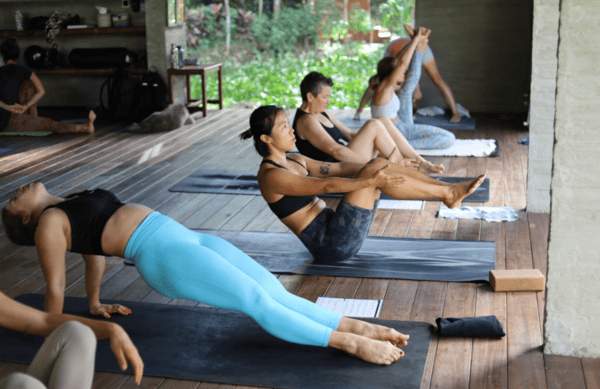
Tera arrived in Canggu with a carry-on, a slightly torn copy of The Yoga Sutras, and the vague plan of "doing more yoga." She'd been practising on and off for two years in London — mostly YouTube videos on Sunday mornings, occasionally a studio class when work allowed. She was not, by any stretch, a serious yogi.
Three weeks later, she was waking at 5:45 without an alarm. Her body had changed. Something quieter in her had too.
What happened in between was Ashtanga.
What Is Ashtanga Yoga, Actually?
If you've heard of Ashtanga and found it slightly intimidating, that's fair. It has a reputation for being intense, rigid, and reserved for the flexible. None of that is really true, but the reputation persists.
Ashtanga is a structured sequence of postures — always the same order, always linked by breath. You move through standing poses, seated poses, backbends, and finishing postures, connected by a flowing breath pattern called ujjayi and transitional movements called vinyasas. The same sequence, every day. That's it.
What makes it different from a flow class is the repetition. You're not chasing novelty. You're studying yourself through the same mirror each morning. And Bali, with its warmth and its unhurried mornings, is one of the best places on earth to begin that study.
Why Bali for Ashtanga?
Ashtanga yoga in Bali has roots going back decades. The tradition was carried here by students of Sri K. Pattabhi Jois, and the island has held it gently ever since. There's a reason serious practitioners make the pilgrimage here — not just for the teachers, though there are exceptional ones, but for the environment itself.
The heat helps. Muscles release more easily in Bali's warmth, which means postures that feel impossible in a cold northern studio become approachable here. The humidity, which takes a few days to adjust to, eventually becomes its own teacher in breath control and surrender.
And there's something about the Balinese relationship with practice, ritual, and daily devotion that seeps into your own. When the woman who tends the garden at your guesthouse places a small offering of flowers and rice at the gate each morning, you understand intuitively what it means to show up every day, with care, without fanfare.
The Mysore Format: What to Expect
Some of the most authentic Ashtanga experiences in Bali follow what's called Mysore style — named after the city in South India where the tradition originates. In a Mysore class, everyone practises at their own pace, in the same room, with the teacher moving between students offering adjustments and guidance.
For beginners, this sounds terrifying. For Tera, it was.
"I walked into the shala at Ubuntu Bali on my first morning and everyone else seemed to know exactly what they were doing," she said. "I just stood there on my mat like a complete idiot."
Her teacher, a soft-spoken woman named Putu, came over, smiled, and said: "We start from the beginning. Everyone starts from the beginning."
She was taught five postures that first day. Just five. She was told to come back tomorrow and do the same five again.
This is the Mysore method. You are given only what you're ready for. The sequence unfolds slowly, over weeks and months, one posture at a time. There's no performance. No keeping up. Just you, your breath, and the next shape your body is learning to find.
Starting as a Complete Beginner
You do not need to be flexible to begin Ashtanga. You do not need prior yoga experience. What helps is willingness — to be a beginner, to repeat, to be patient with a body that has its own timeline.
At Ubuntu's daily yoga classes in Canggu, beginners are welcomed into the Mysore room and introduced to the practice gradually. Alternatively, a led primary series class, where the teacher calls out the sequence and everyone moves together, can be a gentler entry point for your first week.
A few things that help in the early days: arrive on an empty stomach (traditionally, Ashtanga is practised first thing in the morning, before eating), wear something you can move and sweat freely in, and leave your expectations at the door. Your hamstrings will not cooperate. That is perfectly fine.
What matters more than flexibility is breath. If you can breathe steadily through discomfort, you can do Ashtanga.
Ready to start? See Ubuntu's beginner-friendly yoga classes in Canggu →
What Changes, and When
By the end of her first week, Tera noticed she was sleeping more deeply than she had in years. By the second week, her lower back — which had ached quietly for most of her twenties — felt different. Not fixed, but attended to.
"The practice doesn't fix you," she said. "It just shows you where you've been holding things."
This is what long-term Ashtanga practitioners describe again and again. The physical changes come — strength, flexibility, a kind of groundedness in the body. But the subtler shifts are often more significant. More patience. A different relationship with discomfort. A capacity to stay present when the mind wants to wander.
Bali holds these changes well. The simplicity of life at an eco retreat, the organic food at Ubuntu Cafe, the community of people around you doing similar work on themselves — all of it creates a container that makes transformation feel less dramatic and more natural. Like something that was always possible, just waiting for the right conditions.
A Few Practical Notes Before You Go
Morning practice is usually best between 6 and 8am, before the day heats up fully. Give yourself time to walk or cycle to the shala slowly — arriving rushed undoes some of what you're there for.
Bring a light towel, a reusable water bottle, and something warm for the finishing postures, when the body cools quickly. Most shalas in Canggu are open-air, which means the occasional gecko on the wall and the sound of rain on a bamboo roof during savasana. Neither of these are problems.
And if you have a day where nothing works — where your body is tight, your mind is loud, and the whole thing feels pointless — go anyway. Show up, do what you can, and leave. That day is part of the practice too. Often it turns out to be one of the more important ones.
Ashtanga doesn't ask you to be good at it. It only asks you to come back.