
Eat Like You Mean It: Plant-Based Food in Canggu That Feeds the Practice
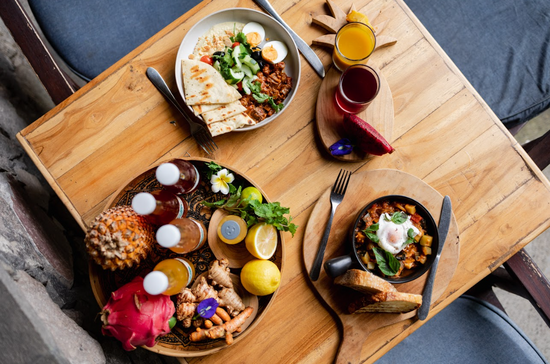
After a morning yoga class, something shifts in the body. The muscles are warm, the mind is quieter than it's been all week, and suddenly you're ravenously, joyfully hungry. What you eat in that window matters more than people realise. Not in an anxious, tracking way — but in the way that good food after genuine movement feels like the last piece of something clicking into place.
In Canggu, you don't have to go far to find that meal. But not every café that calls itself healthy actually nourishes you. This is a guide to understanding what to look for, and why the food you eat near your mat is as much a part of your practice as the practice itself.
Why Food and Yoga Belong Together
In yogic philosophy, the concept of ahimsa — non-harming — extends to what we eat. Choosing plant-based, locally sourced food isn't just a wellness trend. It's an extension of the same values that bring people to the mat. Kindness toward the body. Respect for the earth. Awareness of the living chain that makes a meal possible.
Bali understands this intuitively. The island's food culture has always been tied to the land, to seasonality, to gratitude. The Balinese make daily offerings of rice and flowers not as ritual performance but as genuine acknowledgement: that life is sustained by forces larger than ourselves, and those forces deserve recognition. Eating a bowl of food made from things grown in the same soil you practised on that morning carries that same spirit. It is, in its own small way, a spiritual act.
This is why the best plant-based cafes in Canggu feel like extensions of the yoga studio rather than separate stops on a to-do list. The intention carries through.
What Ayurveda Teaches Us About Eating After Practice
Long before nutrition science gave us macros and micronutrients, Ayurveda — the ancient Indian system of medicine that yoga grew alongside — had a sophisticated understanding of how food affects the body, mind, and spirit.
Ayurveda recognises three fundamental constitutional types, or doshas: Vata (air and space), Pitta (fire and water), and Kapha (earth and water). Most people are a combination of these, with one or two dominant. And crucially, the way you eat — not just what you eat, but when, how warm, how spiced, how heavy — should support your particular constitution.
After a vigorous Ashtanga or Vinyasa practice, for example, Pitta energy tends to run high. The body has generated heat, the digestive fire is strong, and food that is cooling, hydrating, and lightly sweet will restore balance better than something heavy or overly spiced. After a slow Yin or restorative class, Vata may need grounding — think warm grains, root vegetables, a little healthy fat.
This is why Ayurveda has always insisted that food is medicine. Not in the supplemental sense, but in the most ordinary, daily sense: that what you put into the body either supports its intelligence or works against it.
A café that understands this — that thinks about food the way a yogi thinks about practice — is a rare and genuinely valuable thing.
What Makes a Cafe Genuinely Nourishing
There's no shortage of smoothie bowls and açaí in Canggu. Instagram has seen to that. But there's a real difference between food that photographs well and food that actually restores you after an hour of sweating on the mat.
After yoga, the body needs real nourishment: protein to support muscle recovery, complex carbohydrates to replenish energy, and hydrating foods to replace what the heat took. From an Ayurvedic perspective, the digestive fire — agni — is active after morning practice, which means the body can absorb nutrients well. But overloading it with cold, raw, or heavy foods can dampen that fire. Warm, light, and easy-to-digest is the traditional guidance.
What that looks like in practice: a warming congee or grain bowl with seasonal vegetables. A golden milk or spiced chai. A broth made slowly, with ginger and turmeric. Fresh fruit that grew nearby. Food that came from someone's hands, not a factory.
At Ubuntu Cafe Bali, the menu was built with exactly this in mind. Just steps from our shala, it's the kind of place where you can walk in from practice still barefoot and no one bats an eye. The smoothie bowls are made with local fruit. The grain bowls are properly filling without being heavy. The broths are slow and warming. Nothing on the menu is trying too hard to impress you. It's just quietly, consistently good.
A Morning at Ubuntu Cafe
Lena came to Canggu from Amsterdam for ten days. She'd booked herself into a retreat, not quite sure what to expect, and ended up spending most of her non-yoga hours at Ubuntu Cafe.
"I'd finish the morning class and just walk straight over," she said. "I'd sit there for an hour, sometimes two. I had the coconut porridge almost every day. I wasn't even trying to be healthy — it just felt like what my body wanted."
What Lena was experiencing is something a lot of people notice after a few days of consistent yoga practice in Bali: the body begins to self-regulate. It stops reaching for the things it craved out of stress or habit, and starts asking for what it actually needs. Ayurveda calls this the awakening of prajna — bodily wisdom, the innate intelligence of the system when it's no longer being overridden by noise.
A café that meets that request, with organic ingredients, no unnecessary additives, food prepared fresh that morning, becomes less of a convenience and more of a daily ritual.
The Ubuntu Cafe sits in a garden setting, surrounded by the same greenery that frames the yoga shala. There's an ease to eating there that goes beyond the menu. You're still outside. Still connected to the trees and the light and the sounds of the morning. The transition from practice to nourishment happens without interruption, which is itself a kind of medicine.
The Organic Difference
The word "organic" gets used casually, but it carries real meaning when you're eating close to a yoga practice. Pesticide residue, processed oils, and artificial ingredients place a quiet burden on the body's systems — the very systems you're working to support through movement and breath.
From an Ayurvedic standpoint, food grown in living soil carries more prana — life force — than food grown with chemicals, picked early, and shipped across the world. This is not mysticism. It aligns with what we understand about nutrient density, soil health, and the relationship between the microbiome of the earth and the microbiome of the gut.
Ubuntu Cafe Bali sources ingredients locally and organically wherever possible, working directly with small Balinese farmers who share the same values around land and food. The vegetables were grown in Balinese soil. The fruit is seasonal. The food didn't travel far to get to your plate, and that matters — for the quality of what you're eating, for the farmers who grew it, and for the environmental cost of the meal.
Behind the kitchen is chef Nikki, who is also a yoga practitioner and teacher. That dual life isn't incidental. It means the menu was designed by someone who knows what the body needs before and after practice, who understands the relationship between food and the nervous system, and who genuinely cares about where ingredients come from. For Nikki, cooking and teaching yoga come from the same place: a belief that how we nourish ourselves is a reflection of how we see the world. Ubuntu Cafe was never meant to be just a café. It was meant to be part of the practice.
It also means the menu shifts with what's available. Which is, in its own way, the same lesson the yoga practice keeps offering: work with what's here, not what you wish were here. Presence over preference.
The Three Gunas: Eating for Clarity
Yogic philosophy also describes food in terms of the three gunas — qualities of energy that exist in all things. Sattvic foods are pure, light, and clarity-producing: fresh fruit, vegetables, whole grains, nuts, dairy, honey. These are the foods traditionally recommended to support meditation and spiritual practice. Rajasic foods stimulate and agitate: spicy, salty, overly stimulating. Tamasic foods dull and heaviness: stale, overprocessed, fermented.
A sattvic diet doesn't mean joyless eating. It means choosing food that leaves you feeling light, clear, and energised rather than sluggish or wired. After a few days of eating this way in Bali — surrounded by the natural beauty that reinforces the same values — many people find their mind noticeably quieter. Their practice deepens. The connection between plate and mat becomes undeniable.
More Than a Meal
What keeps people coming back to Ubuntu Cafe isn't just the food. It's the feeling of the whole morning as one unbroken thing. You wake, you practise, you eat, you sit in the garden and let the day come slowly. The yoga retreat eco living philosophy that runs through Ubuntu Bali doesn't stop at the shala door. It lives in the kitchen too.
Whether you're on a week-long retreat, dropping into a daily yoga class in Canggu, or simply staying nearby and looking for somewhere to eat that feels in alignment with how you want to feel — Ubuntu Cafe is the kind of place that earns its place in your morning, and then your memory, long after you've flown home.
Some cafes feed you. Some actually nourish you. There's a difference, and once you've felt it, you stop settling for anything less.
Come hungry. Come as you are. Find us at Ubuntu Bali, Canggu →
Good food, like good yoga, doesn't need to announce itself. You just feel it.