From Asana to Action: Yoga and Ecology at Ubuntu Bali
Most yoga retreats will tell you they're eco-friendly. They'll mention their bamboo straws and solar panels, check the sustainability box, and move on. But here's what nobody talks about: what happened in Bali in September 2025, when floods killed 18 people—floods made worse because trash clogged the drainage systems.
An eco yoga retreat shouldn't be about aesthetics or marketing. It should be about understanding that how we practice yoga and how we live on this earth are inseparable. That ahimsa—non-harm—extends beyond our interactions with people to every plastic bottle we refuse, every liter of water we don't waste, every chemical we choose not to pour into Bali's already stressed water table.
At Ubuntu Bali, we practice yoga in a place where sustainability isn't an add-on feature. It's woven into everything—not because it's trendy, but because after living here for 15 years, watching this island struggle under the weight of tourism and development, we couldn't do it any other way. We're not certified eco-friendly; that certification costs more than a small retreat can afford. But we sort our waste, compost our scraps, make our own chemical-free soaps, change sheets weekly instead of daily, and install dry toilets that most guests would rather avoid.
Why? Because a yoga retreat that talks about mindfulness while generating mountains of waste and guzzling resources makes no sense. The practice either matters in how we live, or it doesn't matter at all.
Why Canggu, Why Ubuntu
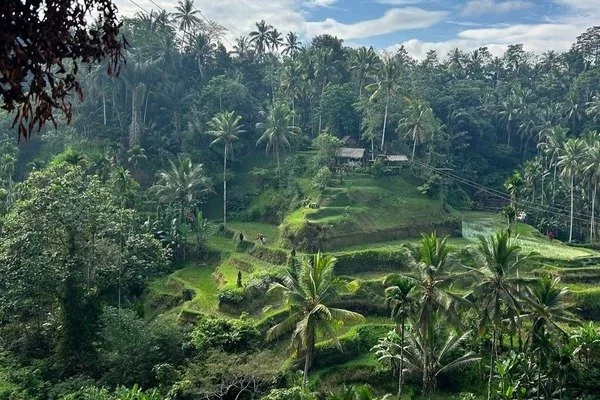
Canggu has become known for its surf breaks, cafes, and creative energy. But beneath the buzz exists another rhythm—one of rice paddies being tended by hand, offerings placed at temple gates each morning, a culture that still remembers living in harmony with nature.
Ubuntu Bali sits within this duality. We're close enough to Canggu's vibrant energy that you can explore when you want to, yet set back in a quieter pocket where you can actually hear yourself think. Where you can practice yoga in open-air shalas with nothing between you and the sky, eat food picked from organic gardens that morning, and sleep in rooms designed for rest rather than Instagram.
Our co-founder Andréa, who has called Bali home for 15 years, grew up in Sweden where respecting nature wasn't a trend but a way of life. She brought that mindset here, adapting it thoughtfully to this Balinese setting. We don't have an official eco-certification—that's financially out of reach for a small retreat like ours. But we don't need a certificate to know what's right.
Accommodation That Breathes
Our rooms are simple, intentional spaces. We've removed bath plugs from tubs because Bali faces water scarcity most visitors never see—in places like Uluwatu, salt water now infiltrates the wells. We provide thin towels instead of heavy pool towels. We change sheets and linens once weekly rather than daily, because clean doesn't require waste.
Each room has fans alongside air conditioning, and we genuinely encourage guests to use them. When you open the windows and let the tropical air move through, you'll understand why Balinese architecture was designed around cross-ventilation long before electricity existed.
We've installed dry toilets next to our yoga shalas—admittedly not everyone's preference, but functional and water-saving in a way that matters here. These aren't deprivations; they're invitations to live more consciously, even on holiday.
Yoga as Practice, Not Performance
The yoga we offer—Ashtanga, Vinyasa, Yin, meditation—happens in shalas where garden lights run on automatic switches and the primary illumination is sunlight. There's no climate control, no perfectly curated temperature. You practice as bodies were meant to: adapting, breathing, finding steadiness amid whatever conditions arise.
This too is yoga. Not controlling every variable, but meeting what is with presence and breath.
A few weeks ago, someone asked during breakfast why we bother with dry toilets when most guests would prefer regular ones. It started an unexpected conversation. One guest mentioned she'd been mindlessly wasting water her whole life until she saw the empty wells in her room's bathtub. Another talked about how eating the same simple, organic meals every day made her realize how much anxiety she normally carries around food choices. Someone else admitted they'd been annoyed about the once-weekly sheet change at first, then felt embarrassed when they learned about Bali's water crisis. These aren't the polished testimonials you'd see on a website. They're the messy, real moments when people start connecting what happens on their yoga mat—the breath, the awareness, the letting go of preferences—to how they actually live.
Food from Soil to Soul
At Ubuntu Cafe, we serve organic, plant-based food sourced from local farmers who work the land sustainably. This isn't about dietary trends or virtue signaling. It's about eating food that came from healthy soil, prepared by hands that care, shared in community.
When your body is nourished by food grown without chemicals, picked at peak ripeness, cooked simply—you feel different. Clearer. More connected to the chain of life that feeds us all.
We provide filtered water instead of endless plastic bottles. We give guests reusable Ubuntu fabric bags for market trips. Small gestures that, multiplied across hundreds of visitors yearly, actually matter.
The Whole Picture
Behind the scenes, we sort waste into separate bins. Organic garden waste goes to Urban Compost and returns as soil nutrition for local gardens. Food scraps go to our friend Ketut, who feeds his pigs and embodies the Balinese principle that nothing need be wasted. Old linens become cleaning rags, shopping bags, curtains—the creative reuse Andréa learned in Sweden and adapted here.
Our homemade mosquito spray, body wash, and cleaning soaps use soap nuts and locally-made essential oils. They smell incredible and contain zero chemicals. Guests often ask to buy bottles to take home, surprised that natural products can actually work.
These aren't amenities we list to seem virtuous. They're simply how we've chosen to run this space, knowing that every chemical-free soap, every sorted piece of waste, every conserved liter of water is a small act of love for this island.
Step Into a Different Rhythm
What we're offering isn't a typical vacation. It's an invitation to slow down, to live more intentionally even if just for a week, to discover that less—less waste, less consumption, less controlling—can actually feel like more.
You'll practice yoga where the only sounds are breath and birdsong. You'll eat food that still carries the memory of sunshine and rain. You'll sleep in simple rooms and wake feeling somehow more rested than in five-star hotels. You'll be part of a small community that believes our daily choices matter.
Ready to experience yoga and eco-conscious living as one integrated practice? Book your stay at Ubuntu Bali today. Spaces are limited—we're intentionally small to minimize our footprint and maximize genuine connection. Let your retreat be part of the solution.
Early booking recommended. Come practice, rest, and live in alignment with nature.