Exploring Your Practice: The Path of Ashtanga Yoga in Bali
There's something about arriving at the yoga shala before dawn. The air is still cool, carrying the scent of frangipani and incense. You roll out your mat in the quiet, joining others who've also chosen to begin their day this way—not with coffee or screens, but with breath and movement, with an ancient practice that asks everything of you and, somehow, gives even more back.
This is Ashtanga yoga. And in Bali, at Ubuntu Bali in Canggu, this practice finds a home that honors both its roots and its evolution.
What Makes Ashtanga Different
Ashtanga isn't gentle. It doesn't promise immediate relaxation or easy answers. Instead, it offers something more valuable: a mirror. Through its set sequences of postures linked by breath—what we call vinyasa—you meet yourself exactly as you are each morning. Strong some days, struggling others. Focused or scattered. Resistant or surrendering.
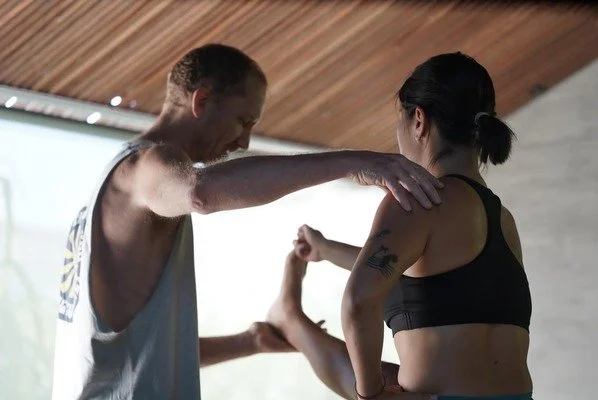
The practice is traditionally taught in Mysore style, named after the city in India where Sri K. Pattabhi Jois established the method. Unlike typical led classes, Mysore practice is deeply personal. You move through the sequence at your own pace while the teacher observes, adjusts, and guides you individually. You memorize the series gradually, building it into your body until the movements become meditation.
At Ubuntu Bali, Mysore Ashtanga sessions run Monday through Friday, 7:15-9:15 AM—the traditional morning practice window when, according to yogic philosophy, the mind is clearest and the body most receptive.
The Teachers Who Hold the Space
Ubuntu Bali's Ashtanga program is guided by two teachers whose combined experience spans decades of dedicated practice and study.
Andréa Drottholm discovered Ashtanga in Barcelona in 2003, and it transformed her life completely. Since then, she's made the pilgrimage to Mysore, India twice yearly to study under Sharath Jois at the K. Pattabhi Jois Ashtanga Yoga Institute—a commitment that speaks to her devotion. Now an authorized Level 2 teacher through KPJAYI, Andréa brings more than technical precision to her teaching. Between morning practices in the shala, she studies philosophy and practices chanting, understanding that yoga extends far beyond the mat. Her background in life coaching enriches how she supports students through both the physical challenges of the practice and the emotional, psychological terrain it inevitably reveals.
Damien de Bastier has walked the path of yoga and meditation for over 30 years. Introduced to meditation as a struggling teenager at 15, he found tools that would shape his entire life. His journey has taken him through psychology, various healing modalities, men's work, and the 12 steps—all of which inform his compassionate, humor-filled teaching. Originally from France, Damien has lived abroad for 24 years and co-founded Samadi Bali before establishing Ubuntu. He teaches Ashtanga not as dogma but as a living practice that supports students in becoming more fully themselves.
Both teachers understand what it means to show up day after day, year after year, to a practice that continually humbles and transforms.
Why Practice in Bali
Bali has become a global yoga destination, but not without reason. There's an energy here—the Balinese call it taksu—that supports spiritual practice. The island's Hindu traditions create a culture where offerings, ceremony, and devotion are woven into daily life. You're reminded constantly that the material and spiritual worlds aren't separate.
Canggu, where Ubuntu Bali is located, balances the energy of modern creativity with access to rice fields, beaches, and a genuine yoga community. It's a place where you can practice intensively while also living fully—surfing, exploring, connecting with others on similar paths.
Beginning the Journey
If you're new to Ashtanga, the practice can feel intimidating. The sequences look impossibly fluid when experienced practitioners move through them. But every Ashtangi started exactly where you are—learning sun salutations, discovering which leg goes forward first, wondering if they'd ever bind in a twist.
The beauty of Mysore-style practice is that you begin where you begin. Your teacher will give you a few poses, and you'll work with those until they become familiar. Gradually, more are added. There's no rushing, no competition. Just consistent practice and whatever unfolds from that.
Some days the practice will feel like flying. Other days like pushing through mud. Both are practice. Both are yoga.
The Philosophy Underneath
Ashtanga is built on the eight-limbed path outlined by Patanjali—yama (ethical restraints), niyama (observances), asana (posture), pranayama (breath control), pratyahara (sense withdrawal), dharana (concentration), dhyana (meditation), and samadhi (absorption). The physical practice is just one limb, a gateway to the others.
When you commit to showing up on your mat regularly, you're not just building strength or flexibility. You're cultivating abhyasa (consistent practice) and vairagya (non-attachment to results). You're learning to witness yourself with honesty and compassion. You're discovering that power switch Andréa speaks of—the one that, when turned on, makes life flow differently.
Your Practice Awaits
The mat is rolled out. The morning light is beginning to filter through the shala windows. Your breath is waiting to be discovered, again and again and again.
At Ubuntu Bali, you'll find more than classes—you'll find a practice that can anchor your life, teachers who've walked this path with dedication and heart, and a community that understands why we return to our mats even when it's hard. Especially when it's hard.
Whether you're an experienced Ashtangi looking to deepen your practice or someone curious about beginning this transformative journey, Ubuntu Bali offers the guidance, space, and tradition to support you.
The practice is waiting. Book your class and discover what becomes possible when you show up for yourself, one breath at a time.
Find Ubuntu Bali in Canggu and join Monday-Friday Mysore Ashtanga sessions, 7:15-9:15 AM. Follow @andreacanggu and @yogadamien for inspiration and updates.