
From Overwhelm to Awareness: What Actually Helps You Stay Present During a Retreat
You have booked the retreat. Cleared your calendar. You arrive with high hopes of finally feeling calm, centered, present.
Then day two hits and your mind is still spinning. You are physically in Bali but mentally replaying last month's work crisis. The silence you thought would be peaceful feels awkward. The meditation you hoped would bring clarity just makes you aware of how restless you actually are.
If this sounds familiar, you are not broken. You are just human. And there are specific, practical ways to work with this instead of against it.
Why your mind won't shut up
Your nervous system has been in high-alert mode, possibly for months or years. When you suddenly remove external demands and distractions, your brain doesn't instantly relax. It often gets louder, scanning for the next problem to solve because that's what it's been trained to do.
Research shows that our default mode network, the part of the brain active during rest, often defaults to rumination rather than true rest. This is especially pronounced in people experiencing burnout. Your brain literally needs to relearn what safety feels like.
This is why presence isn't something you force. It's something you gradually create conditions for. At Ubuntu Retreats, our intimate setting means you're not lost in a crowd of hundreds, but held in a small community where your nervous system can actually register safety.
What to do in the first 48 hours
Let yourself be uncomfortable. Don't immediately fill the space with activities. Sit with the restlessness. Notice it without trying to fix it. Ubuntu's serene atmosphere, tucked between rice fields and traditional Balinese homes, gives you permission for this discomfort without the pressure to perform relaxation.
Move your body first, meditate second. Physical movement helps discharge nervous energy that makes stillness difficult. Our morning yoga classes at Ubuntu are specifically structured for this. We practice in an open-air shala where you can hear the rice fields and feel the morning breeze. The classes aren't about perfect poses. They are about reconnecting with your body as a way back to presence.
Use your breath as an anchor. You don't need special breathing techniques yet. Just notice: am I breathing? Is it shallow or deep? Count ten breaths. That's presence.
Write it out before sitting. Keep a "brain dump" journal. Before meditation, spend five minutes writing everything your mind is churning about. This tells your brain "we have captured this, you can rest now."
Practices that actually work
Walking meditation without formality. Pick a path, maybe simply around the Ubuntu garden. Walk at whatever pace feels natural. When your mind wanders to planning or rehashing, just notice "thinking," and bring attention back to your feet touching ground. At Ubuntu, these paths are right outside your door.
Eating one meal in silence. Notice texture, temperature, flavor. When thoughts come, acknowledge them and return to taste. Our communal meals at Ubuntu create space for both connection and silence. Sometimes the table is full of laughter. Sometimes people eat quietly, together but internal. Both are welcome.
The 5-4-3-2-1 grounding technique. When overwhelm hits, name: 5 things you can see, 4 you can touch, 3 you can hear, 2 you can smell, 1 you can taste. This drops you back into sensory reality.
When resistance shows up
Around day three or four, many people hit a wall. The novelty has worn off, you're not instantly transformed, and part of you wants to check email.
This is the moment before the breakthrough.
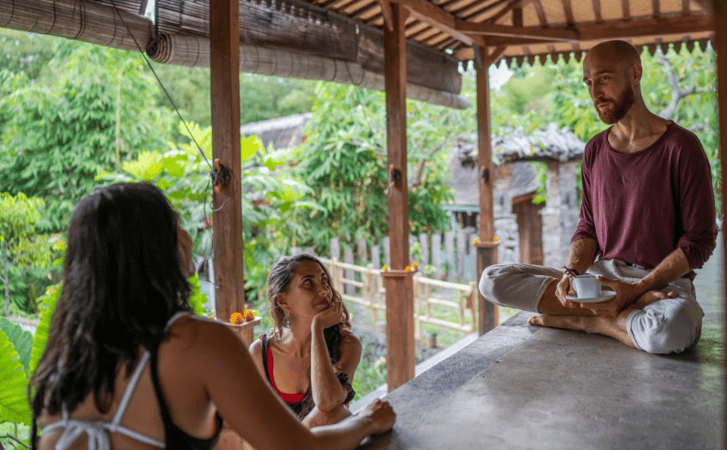
What helps: Talk to someone. Say "I'm feeling restless and I don't know why." The beauty of Ubuntu's intimate community is that these conversations happen naturally, over tea or after yoga. Do something completely unrelated. Read, draw, nap. Presence doesn't mean constant meditation. Remember why you came. Not to achieve perfect mindfulness, but because something wasn't working. You're here to recalibrate.
The shift from doing to being
Somewhere, usually when you stop trying so hard, something shifts. You're in Ubuntu's yoga shala and instead of mentally critiquing your form, you're just breathing and moving, aware of the others around you also breathing and moving, all of you imperfect and present together.
Or you are lying in bed at night listening to evening sounds, feeling the breeze through your window, held by the serene atmosphere that Ubuntu creates not through luxury but through simplicity and genuine care.
These moments are presence. Not the Instagram version. The real version, which is simpler and more ordinary than you expected.
What to bring home
You can't maintain retreat-level presence in regular life. What you're building is the skill of noticing when you've left the present moment, and the ability to return.
Micro-practices for real life: Three conscious breaths before opening your laptop. One meal per week without devices. A five-minute sit each morning, even messy. Noticing physical sensations during difficult conversations.
The goal isn't to become a meditation master. It's to develop a relationship with presence as a resource you can access when life gets overwhelming again. And you'll have the memory of what real presence feels like, cultivated in Ubuntu's yoga classes, deepened through connection with others on similar journeys, supported by an environment designed for exactly this kind of gentle transformation.
Ubuntu Bali provides the space and structure to develop real mindfulness practices that work beyond the retreat. Our intimate community, daily yoga classes, and serene atmosphere create the conditions for presence without pressure.