
You Are Not Where You Think You Are
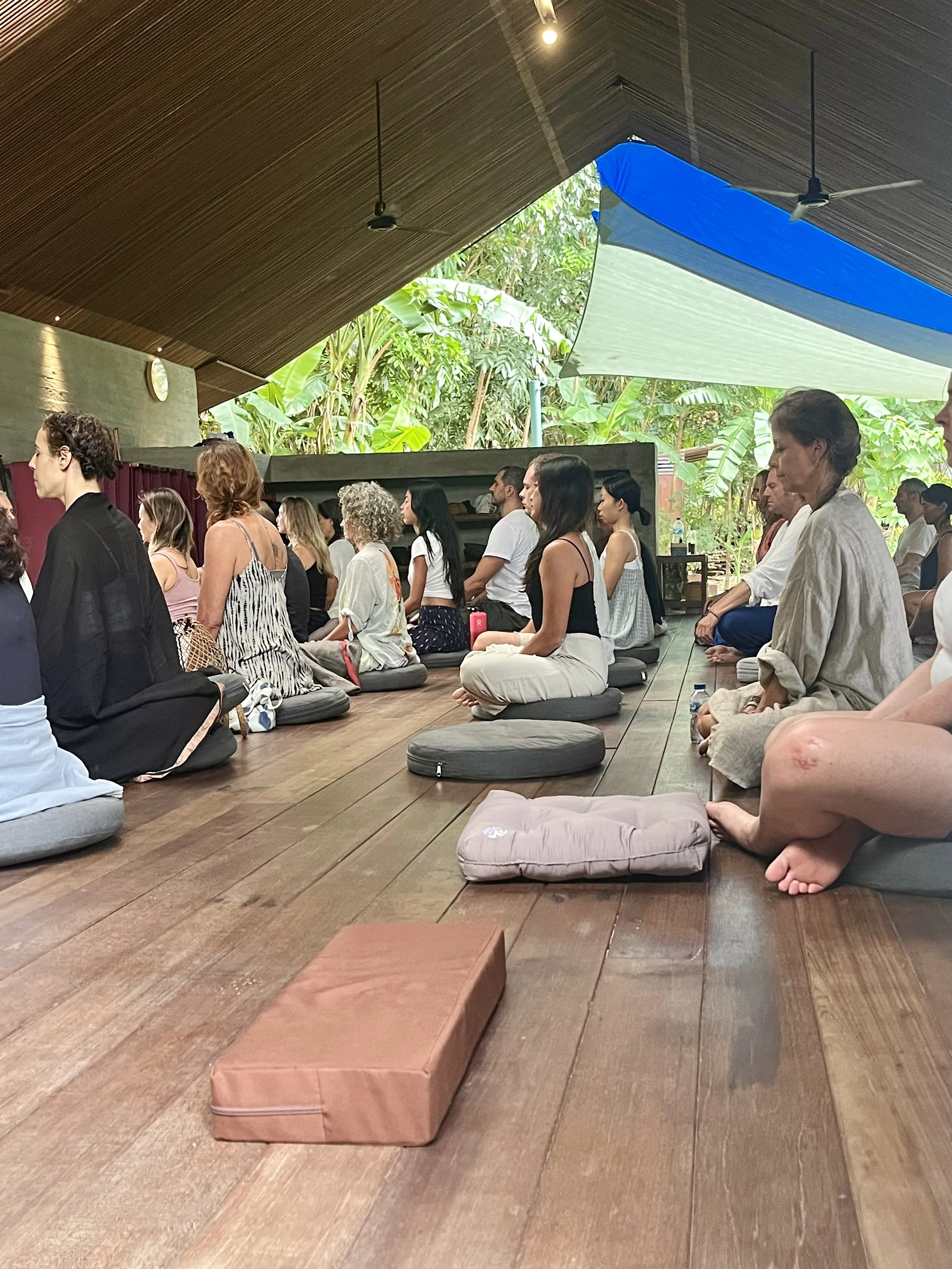
On being present, and why meditation is the only tool that actually works
You have probably heard it more times than you can count. Be present. Live in the now. Stay in the moment. And yet, here you are, in the middle of a perfectly fine Tuesday, mentally composing an email you haven’t written yet while also replaying something someone said to you in 2019.
The reason those phrases don’t actually land is not because they’re wrong. It’s because you can’t think your way into the present moment. You have to practice your way there.
That’s what meditation is for. Not as a spiritual concept, not as a wellness trend, but as a genuine, repeatable practice that changes how you relate to your own mind.
Why We Suffer From Being Somewhere Else
According to Vedanta — the ancient teachings rooted in the Vedas — the primary source of human suffering is not what happens to us, but a fundamental case of mistaken identity. We have forgotten what we actually are. And in that forgetting, we go looking for ourselves in all the wrong places.
The idea is this: your true nature — what the ancient texts call the Atman — is already whole. Already complete. It does not need to be validated, proven, found, or earned. But because we have grown up experiencing ourselves as separate, individual beings — separate from each other, separate from the world, separate from whatever you want to call the larger intelligence behind all of this — we spend most of our lives trying to fill a gap that isn’t really there.
That search shows up in thoughts like:
“No one really understands me.”
“I’m already past 30 and I still haven’t…”
“Everyone else seems to have it figured out.”
Sound familiar? Good. Because that means you’re paying attention. Those thoughts are not the problem itself. They are a signal. They are pointing to the one thing that would actually help: learning to stop taking them as the truth.
Why Telling Yourself to “Stop Thinking” Does Not Work
Here is the thing about the idea that “your thoughts are not your reality”. We nod when we hear it. We write it on a sticky note. We say yes, absolutely, I completely agree. And then something mildly threatening happens — someone laughs nearby and you catch yourself wondering if it’s about you, or you get an unexpected email and your stomach drops — and every bit of rational understanding vanishes instantly.
That is not a personal failure. That is your nervous system doing exactly what it was designed to do. The fight-or-flight response is ancient and fast and not particularly interested in your spiritual development. When it kicks in, the thinking brain steps aside and the survival brain takes over.
This is also why just reading about presence doesn’t create it. You need the experience before you can trust the concept. And you get that experience through practice.
What Meditation Actually Trains
Meditation is not about emptying your mind. Anyone who has sat still for five minutes knows that the mind does not empty. The thoughts keep coming. What changes, over time and with consistency, is your relationship to them.
When you sit down to meditate, you give the mind a focus. The breath, a sensation, a point of stillness. You will lose that focus. Constantly. That is not a problem; that is the practice. Each time you notice you’ve drifted into thought and you return — without drama, without judgment — you are building something. You are training the capacity to direct your own attention.
What the yogis understood, and what modern neuroscience is increasingly confirming, is that this is not a passive or automatic ability. It has to be developed the same way a muscle develops. And like a muscle, it responds to repetition over time, not to one heroic effort.
With enough practice, something shifts. You begin to notice a small but significant gap between a thought arising and you reacting to it. Just a split second of clarity. A moment where you are watching the thought rather than being the thought. That gap is everything. It is what the teachings mean when they talk about seeing beyond the subjective, separate sense of self. It sounds abstract until you feel it. Once you feel it, even briefly, you will want to find it again.
This Is Also Why You Can’t Focus at Work
Let’s bring this somewhere practical for a moment.
We live in a world that has been engineered, quite deliberately, to fragment attention. Your phone, your feed, your inbox — all of it is designed to pull you away from wherever you currently are. The result is that most people end a day feeling like they accomplished almost nothing, even when they were technically busy the entire time. Because being busy and being focused are not the same thing.
But even without any external distractions, the mind is already doing this on its own. Your brain is constantly associating. The book on your desk reminds you of the friend who lent it to you, which reminds you that you haven’t called them, which pulls you three steps away from what you sat down to do. You didn’t open a single app. You were still completely elsewhere.
The practice of meditation addresses this directly. When you train yourself to return, again and again, to your chosen point of focus during meditation, you are building the exact same skill you need to stay in your flow at work, in a conversation, in your own life. You are learning to choose where your attention goes rather than just following wherever it wanders.
On Consistency, Because It Cannot Be Avoided
Here is where the less exciting truth comes in. Meditation practiced randomly, the same way most people approach yoga or any other wellness habit, will produce random results. You might feel a little calmer after a session. You might not. But the deeper change — the actual rewiring of how you relate to thought, the expansion of that gap between stimulus and reaction, the growing ability to stay present — that only comes with regularity.
This is not spiritual discipline for its own sake. It is just how the mind works. The same way you cannot get stronger by going to the gym twice in January and once in April, you cannot train your attention through occasional effort. The consistency is the practice.
The changes are subtle at first. You might not even notice them directly. But one day you will realise that you let something go more easily than you used to. Or that you sat down to work and stayed there, without quite knowing why it felt different. Or that a thought that would normally have sent you into a spiral just… passed.
The Present Moment Is Not a Destination
Being present is not a state you arrive at and then maintain forever. It is something you return to, over and over, the same way you return to the breath in meditation. The practice and the life are not separate things.
The ancient teachings were pointing at something real when they said that suffering comes from not recognising your own nature. What they meant is exactly this: that we spend most of our lives somewhere other than where we are, chasing a sense of wholeness that was never actually missing. The present moment — this one, right now — is the only place where that wholeness is available.
Yoga if done consciously is an active meditation, where breath meets the body and they dance together , meanwhile you tap into the feeling of this dance, smoothing the moves to make it as fluid as you can by using your breath as how you create that smoothness. Imagine yourself blowing a feather and watching it move, can that be your practice and one form of meditation?
Meditation does not give you peace. It gives you the ability to find it, again and again, in the only place it has ever been.”
Come and try one of our yoga classes or sitting in a group meditation every Monday happening at Ubuntu, check our schedule.