The AI Honeymoon Is Over
It's a topic that seems to come up more and more these days around dinner tables, over coffee with friends, and everywhere online.
I'll be the first to admit I had my AI honeymoon.
I was genuinely amazed by what it could do and how quickly it was evolving. Before I knew it, I was asking it everything: how to find cheap flights to Europe, the latest regulations in Indonesia, Gene Keys interpretations, tarot readings (which, I have to admit, were surprisingly entertaining), sustainable building ideas, editing my writing, creating blogs, designing graphics for Ubuntu, analysing spreadsheets... the list became endless.
So what have I noticed in this relationship I've built with AI?
The first thing is that AI slowly gets to know you. The more you use it, the more it adapts its answers to you. At first that sounds wonderful.
But is it?
Sometimes it feels less like getting objective advice and more like talking to a friend who loves you so much they hesitate to challenge you. It often tells you what fits your way of thinking rather than offering a completely fresh perspective. Not always but often enough that I've started noticing it.
Then there are the mistakes.
I remember thinking my admin nightmares were finally over. I uploaded spreadsheets, clicked a few buttons and—like magic—beautifully organised reports appeared. They looked professional. Convincing, even.
Thankfully, I checked every calculation before using them.
Hidden inside were several mistakes that could have created long-term financial problems for our business. That was a sobering reminder that just because something looks intelligent doesn't mean it's always right.
Maybe I wasn't prompting it correctly.
Maybe AI simply isn't there yet.
Perhaps it's both.
Before diving into AI, I actually completed several courses to better understand how these tools work and how to use them well. Even so, I still feel I'm learning. AI is evolving so quickly that what I experienced a year ago isn't the same technology I'm using today.
Yet something inside me keeps hesitating.
What worries me?
One thing I've become increasingly aware of is how easy it is to recognise AI-created content.
The language.
The graphics.
The emojis.
After a while, they all begin to carry a certain flavour.
The other day a friend told me she'd seen a beautiful poster advertising a children's event. A few days later she spotted the exact same design promoting a completely different event, organised by different people in another town.
That was a little wake-up call.
When I heard that, I told my own team:
"Let's create our own posters again."
Not because AI can't make beautiful images it certainly can but because I don't want Ubuntu Bali to slowly lose its personality.
If there's one thing I value, it's originality.
I'd rather have something imperfect that genuinely came from us than something flawless that looks exactly like everyone else's.
Ubuntu has never tried to fit in.
We've always tried to stand out.
And then there's another concern that keeps coming back to me.
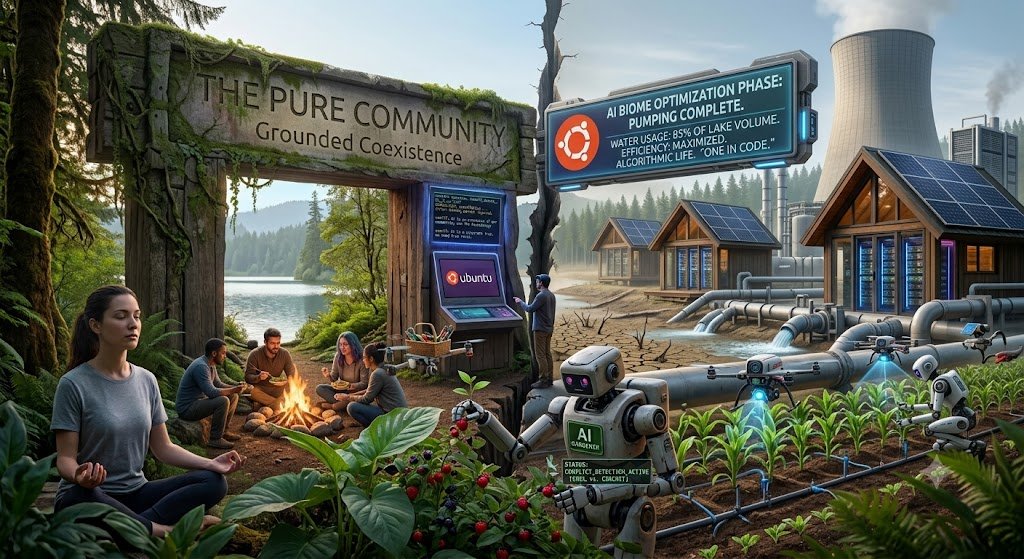
The environmental footprint.
Large data centres require enormous amounts of electricity, and many also consume significant amounts of water for cooling. New technologies are constantly being developed to reduce that impact, which is encouraging, but I still find myself wondering:
Are we solving one problem while quietly creating another?
I honestly don't know.
And maybe that's exactly what makes this conversation so difficult.
Because despite all my doubts, AI has also been incredibly useful.
As a small business with limited resources, it's helped us brainstorm marketing ideas, improve our writing, understand algorithms and move projects forward much faster than we could have on our own.
Sometimes it feels as though you almost have no choice but to keep up. If everyone else is using these tools and you're not, it's easy to feel as though you'll simply disappear into the background.
And that's when another dream quietly appears.
A small farm.
Growing vegetables.
Making things with my own hands.
Living in a community where conversations happen around a dinner table instead of through a screen.
Sometimes I wonder whether progress isn't always about moving forward.
Sometimes perhaps it's about remembering what we've left behind.
Then again...
Maybe it's too early to disappear into the mountains just yet.
I still love meeting people from every corner of the world. I love hearing their stories. I love watching complete strangers arrive at Ubuntu and leave as friends.
Those moments can't be automated.
Those moments are why I do what I do.
Perhaps one day I'll live more simply, a little further away from the noise, growing food, sharing what I've learned with whoever happens to find me.
Not because I want to escape the world.
But because I want to stay connected to the parts of being human that matter most.
Because talking to ChatGPT about your problems will never replace sitting beside someone who simply listens.
AI can't hug you.
It can't look into your eyes.
It can't hold your hand when life falls apart.
It's an extraordinary tool.
But it isn't a human being.
And I hope we never confuse the two.
Maybe the question isn't whether AI is good or bad.
Maybe the real question is this:
What parts of being human are we willing to hand over to technology... and which parts should remain uniquely ours?
I don't have the answer.
For now, I've simply become more intentional about when I use AI—and when I don't.
The honeymoon may be over.
But the conversation is only just beginning.
However to have this tool we are paying a dear dear price which I am not sure is sustainable for the future generation, our resources and our beautiful home planet. We can of course argue that new inventions and solutions are being made, China for example putting their data centres under the sea water to cool the machines down. Is that a solution? Or will that cause more heat in the water which can have its own consequences.
The future generation, what will be the impact for them? Will they completely depend on AI and use their own thinking process and problem solving or simply turn to this technology for answers?
Well all these are questions I ask myself, in the meantime I have minimized my interactions with AI, and the feeling within stays a bit ambiguous…. To use or not to use…
Feel free to share your own thoughts on this heated topic.
With love,
Andréa